
The revenue collection in the same month a year ago stood at Rs 94,442 crore.
The decision to impose a 28 per cent tax on the full face value of bets placed on online games will be implemented from October 1 even though there was demand for a review from states like Delhi and Goa, finance minister Nirmala Sitharaman said on Wednesday. The GST Council -- the highest decision making body of the new indirect tax regime that comprises Union finance minister and representatives of all states -- discussed the language of amendments that will be needed to enabling taxing online gaming, she said after the panel meeting.

The AAP chief stressed the need for an increase in healthcare spending, suggesting a rise to 10 percent of the GDP, along with the removal of taxes on health insurance premiums.

The states which achieved "extraordinary growth" in total taxes collected include Kerala (44 per cent), Jharkhand (20 per cent), Rajasthan (14 per cent), Uttarakhand (13 per cent) and Maharashtra (11 per cent), an official statement said.

The Bills are primarily aimed at helping the MSME sector and small traders, Finance Minister Piyush Goyal said while introducing these in the Lok Sabha

The clarification comes amid reports that sweet shops have discontinued chocolate barfis and chocolate sandesh.
Over 100,000 small and medium-sized businesses are non-compliant with e-invoicing norms under the goods and services tax (GST) regime, a mandatory requirement for businesses with an annual turnover of over Rs 5 crore. E-invoicing provides real-time access to invoices that are prepared by the supplier on the purchase of goods, allowing faster accessibility to input tax credit, thereby limiting the manipulation of fake credit as it has to be generated before the transaction. "The default has been reported mainly in businesses with a turnover between Rs 5 crore and Rs 20 crore," a senior official informed

Deciding the goods and services tax rate on fryums papad could be a messy affair with the Appellate Authority for Advance Rulings (AAAR) of Gujarat now ruling that the ready-to-eat product would draw 18 per cent rate. In that connection, it slightly modified the ruling of the state-based Authority for Advance Rulings (AAR). The AAR had also ordered that these products would draw 18 per cent GST but under a different classification.
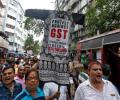
After 17 tumultuous years, a nationwide Goods and Services Tax (GST) will rollout from midnight of June 30, overhauling India's convoluted indirect taxation system and unifying the $2 trillion economy with 1.3 billion people into a single market.

Following passage of the Constitution Bill, 2014, Dass and Finance Minister Himanta Biswa Sarma, who introduced it in the House, exchanged sweets.

Jaitley says govt is open to scrapping 1% additional tax on GST
Tax experts said historically in July and August indirect tax collections remain subdued and pick up with the onset of the festive season post Ganesh Chaturthi.

GSTN said those who do not want to give their Aadhaar numbers would have to undergo physical verification.

As per the ED, a website was engaged in unauthorised online betting in various sports including tennis, cricket, soccer, basketball, badminton and boxing, and live-streamed Indian Premier League matches without any permission.

About a dozen states cutting across party lines on Wednesday pitched for extending the mechanism to compensate states for revenue lost from the implementation of GST beyond June 30, but no decision was taken. Briefing reporters about deliberations at the two-day meeting of the GST Council in Chandigarh, Union Finance Minister Nirmala Sitharaman said finance and other ministers of 16 states spoke on the compensation issue. Of the 16 states, 3-4 spoke of evolving their own revenue stream to break from the compensation mechanism, she said.
Finance Minister Nirmala Sitharaman on Thursday said taxpayer base has almost doubled to 1.28 crore in four years of rollout of the historic tax reform and the enhanced GST mop up in the recent months should now be the "new normal". In a written message to tax officers on the fourth anniversary of GST rollout, she said implementing any reform of this scale in a large and diverse country like India can be highly challenging, but GST has brought about ease in taxpayer compliance and reduced common man's tax burden.

The demand for extension of the GST cess regime among others was made by several state finance ministers at a pre-budget consultation called by Union Finance Minister Nirmala Sitharaman in New Delhi. Besides, many states also demanded raising the share of the Union government in the Centrally Sponsored Schemes (CSS). Currently, the central government and state government share in some CSS is 60:40 while in others it is 75:25.

It's an undeniable fact that after enactment of GST, buying insurance will become a little expensive impacting your term plans, health plans and motor insurance plans the most. But you should not ignore the importance of insuring your life, health, vehicle, says Harjot Singh Narula

Ask rediffGURU and PF expert Nitin Narkhede your mutual fund and personal finance-related questions.

The business would also not be allowed to claim any un-availed input tax credit for "goods lost" or "destroyed".

GST will lead to consolidation of multiple indirect taxes
All GST anti-profiteering complaints would be dealt with by the Competition Commission of India (CCI) from December 1 as the extended tenure of National Anti-profiteering Authority ends this month, an official said on Tuesday. A notification in this regard is expected to be issued by the finance ministry later this month, the official added. The National Anti-profiteering Authority (NAA) was set up in November 2017 under Section 171A of Goods and Services Tax (GST) law to check unfair profiteering activities by registered suppliers.

In a development that may encourage increased investment in commercial real estate, the Supreme Court on Thursday gave the industry relief by permitting input tax credit (ITC) on construction expenses for buildings meant to be leased. "If the construction of a building was essential for carrying out the activity of supplying services, such as renting or giving on lease or other transactions in respect of the building or a part thereof, which are covered by clauses (2) and (5) of Schedule II of the CGST (Central Goods and Services Tax) Act, the building could be held to be a plant," said Justice Abhay S Oka and Justice Sanjay Karol.

States are apprehensive of losing their rights to raise revenue during emergencies.

For every rupee in the government coffer, 58 paise will come from direct and indirect taxes, 34 paise from borrowings and other liabilities, six paise from non-tax revenue like disinvestment and two paise from non-debt capital receipts, according to the Budget documents for 2023-24.

Reform ideas do not occur overnight and evolve over the years.

'The low tax to GDP ratio of the country will go up, helping the government to adhere to fiscal discipline and keep inflation in check.'

The finance ministry has said that the Goods and Services Tax will not apply on room rents of 'sarais' (inns) or properties managed by religious and charitable institutions. The clarification was issued by the Central Board of Indirect Taxes and Customs (CBIC) on Thursday evening to clear the confusion with regard to the levy of GST on room rents. This clarification by the Finance Ministry came following a demand from various quarters including AAP MP Raghav Chadha that the GST on rooms rented by religious institutions be withdrawn.
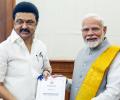
With its age-old fascination for education, southern states have done better than the North. Start-ups, IT hubs, and industry majors setting up shop have changed the face of the South. Nearly 79% of global offices set up by international conglomerates in India are in the South. Almost 46% of tech unicorns are from the South. The GDP per person in the South is 4.2 times higher than the North. None of these indicators can be ignored by any central government, whatever the political compulsions, notes Ramesh Menon.
Mop up grows 10% y-o-y at Rs 1.05 trillion, almost equal to levels in February before a nationwide lockdown to contain the coronavirus pandemic
The government on Tuesday informed Rajya Sabha that GST compensation of Rs 17,176 crore is pending to states as on June 2022. Replying to supplementaries during the Question Hour, Minister of State for Finance Pankaj Chaudhary said the Centre is giving GST compensation to states for five years. He said even during Covid times when no GST was collected, the Government of India had given compensation to states after taking loans of Rs 1.1 lakh crore and 1.59 lakh crore during 2020-21 and 2021-22.

The forthcoming Budget, the last full one before the 2019 Lok Sabha elections, is expected to contain a number of sops and feel-good announcements, especially regarding social sector schemes.
Since its rollout 13 months ago, the new indirect tax has yielded Rs 1 trillion only in in April 2018

'Peninsular Indians could ask 'Why should we contribute half of India's tax revenues if we account for only a quarter of the seats in the Lok Sabha?'.' 'The rest of the country seems likely to counter that 'democracy means one vote per person irrespective of where that person resides in India'.' 'With no easy answers to this thorny debate, the south's economic ascendancy could end up creating a Hobson's choice.' A revealing excerpt from Nandita Rajhansa and Saurabh Mukherjea's book, Behold the Leviathan: The Unusual Rise of Modern India.
As taxpayers face technical glitch on the GST portal, the government on Tuesday said it is considering extending the April tax payment deadline and has directed Infosys for early resolution of the problem. The Central Board of Indirect Taxes and Customs (CBIC) said a technical glitch has been reported by Infosys in generation of April 2022 GSTR-2B and auto-population of GSTR-3B on portal. "Infosys has been directed by Govt for early resolution. Technical team is working to provide GSTR-2B & correct auto-populated GSTR-3B at the earliest," the CBIC tweeted.

The chamber has sought clarity from government to remove uncertainty among businesses

Lack of visibility on rates makes companies apprehensive.
The states have unanimously pitched for sole administrative powers to carry out assessment, scrutiny and enforcement for entities up to an annual turnover of Rs 1.5 crore.

'Perhaps GST was too complex a system for the Indian economy at its present stage of development,' argues T N Ninan.
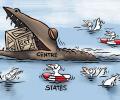
Domestic traders body CAIT on Thursday said that much against the declared spirit of GST as good and simple tax, it has become a "colonial taxation system" not compatible with the ground realities of business in India. Various amendments and introduction of rules under GST in the recent past have made the tax systems system much more complicated and put much compliance burden on the traders, it said in a statement. The Confederation of All India Traders (CAIT) added that it is not alone the centre but largely the state governments are more responsible for distorting the GST taxation system and bringing disparities and anomalies in it which has made it a more complex system and a "big headache" for the traders.
